In the previous post The magic of numbers , we refer to some interesting considerations about the numbers and their relationship to magic and superstition. Always related to this subject, talk about today of magic squares. The first known, in ancient China in the third century BC, is:

Now consider the square of order 4 which is obtained by placing the numbers 1 to 16 as follows:
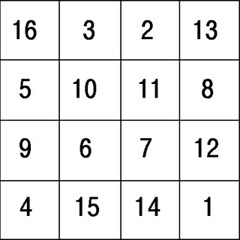
Se puede comprobar, para verificar que es un cuadrado mágico, que la suma de los elemento de las filas, columnas o las dos diagonales es el mismo valor de 34, su suma mágica. Este cuadrado fue incorporado por el pintor Alberto Durero en su ob  ra M elancolía , en la parte superior derecha de la obra y cumple algunas propiedades adicionales, como por ejemplo, incluye la fecha de la pintura en la parte inferior al centro, año 1514, la suma de las cuatro celdas centrales (10,11,6,7), las cuatro esquinas (16,13,4,1) y otras combinaciones simétricas, also added 34, among many other properties, which give a more than magic in this square.
I say there, other than those given above, several squares of order 3 and many others of order 4, and of course the higher we make the order or size of this square, the greater the difficulty of sorting the numbers so as to meet the sum of the elements of each row, column and diagonal is the same. Interestingly, for those of order 4, De Bessy established in 1693 that there are 880 different magic squares. Later it has been shown that there are magic squares of order 275305224 5. For larger orders we only have estimates.
The great American inventor Benjamin Franklin found the magic square of order 8 given by

variations of magic squares, the one that caught my attention is that of order 4 which is incorporated The Passion façade the expiatory church of La Sagrada Familia in Barcelona , monumental and amazing work of Antonio Gaudí , see the kiss of Judas:

The Cryptogram Gaudí, as they call it, is extended:

This magical sum is always 33, in 310 different combinations in groups of four, just to name a few: 1,14,11,7 (subquadrate top left) or 8,10,13,2 (subquadrate bottom left) or 7,6,10,10 (subquadrate interior) or 14,11,6,2 (a cross) or 14,7,9,3 (cross) or 14, 6,10,3 (shingles) or 14,14,2,3 11,8,9,5 or , including yourself can try using geometric shapes or paths.
 Thus, we can use in our classrooms the magic of these squares to motivate our students and, in turn, demonstrate the close relationship that exists between mathematics and art.
Recommended Links:
Magic Squares Magic Squares Let
Chess and Math Games
The genius of the Magic Square Math


0 comments:
Post a Comment